 author
atx vs e atx
E-ATX vs ATX Motherboards in India: Which One Should You Choose in 2025?
In the evolving world of PC building in India, selecting the right motherboard form factor is one of the most crucial decisions you’ll make. Among the various options available, ATX (Advanced Technology eXtended) and E-ATX (Extended ATX) are two popular choices, especially for gamers, streamers, engineers, and content creators looking for high-performance builds.
This article breaks down the differences, advantages, disadvantages, use cases, prices in India, compatibility, and key considerations when choosing between ATX and E-ATX motherboards.
🧩 Understanding the Form Factors: ATX vs E-ATX
🔷 What is an ATX Motherboard?
The ATX motherboard, developed by Intel in 1995, is the most commonly used full-sized motherboard in India. It offers a great balance of size, expandability, and compatibility.
- Standard Dimensions: 12 x 9.6 inches (305 x 244 mm)
- Typical Use: Gaming PCs, workstations, general-purpose high-performance systems
- Expansion: 7 PCIe slots, up to 4 RAM slots (sometimes more)
🔶 What is an E-ATX Motherboard?
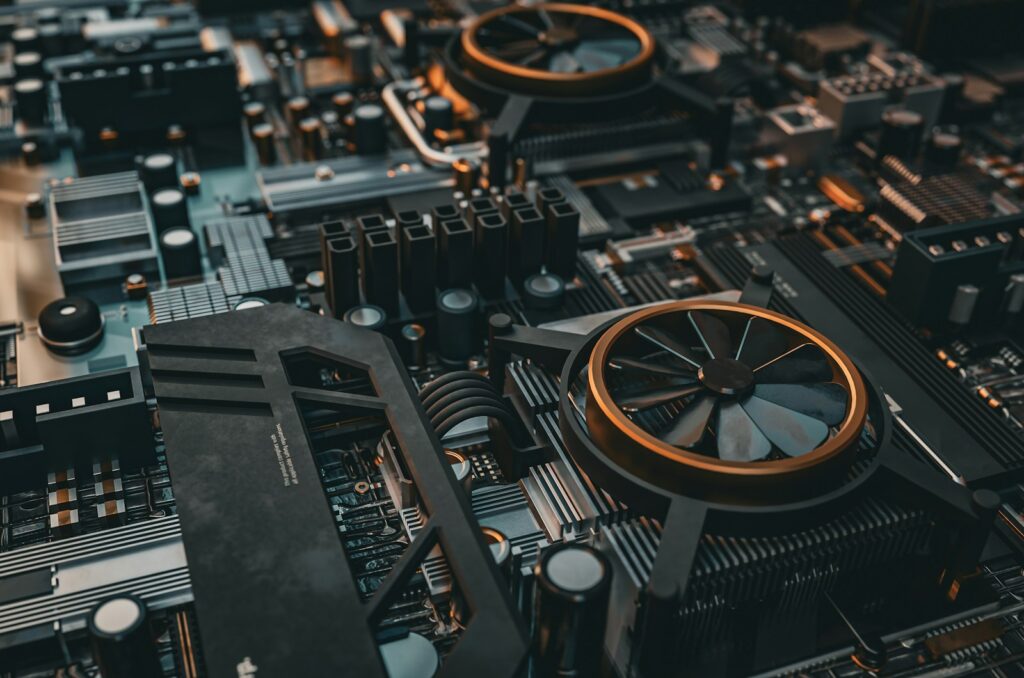
E-ATX (Extended ATX) motherboards are larger and more feature-rich than standard ATX boards. They are designed for high-end workstations and enthusiast gaming builds, and are typically chosen by users who need maximum power, RAM capacity, and cooling support.
- Standard Dimensions: 12 x 13 inches (305 x 330 mm)
- Typical Use: Extreme gaming rigs, content creation, 3D rendering, scientific computing
- Expansion: More PCIe slots, RAM slots, storage ports, VRMs, and often better cooling features
📊 Feature Comparison: ATX vs E-ATX
| Feature | ATX Motherboard | E-ATX Motherboard |
|---|---|---|
| Size | Medium (305 x 244 mm) | Larger (305 x 330 mm) |
| RAM Capacity | Up to 128 GB (commonly) | Up to 256 GB or more (some support ECC) |
| Expansion Slots | Up to 7 | Often 8+ or spaced for GPUs |
| Number of GPUs | 1–2 GPUs | 2–4 GPUs supported (better spacing) |
| Power Phases / VRMs | Moderate to high | High-end / Extreme VRMs for OC |
| Cooling Support | Air + AIO compatible | Better airflow and custom loop support |
| Price in India | ₹9,000 to ₹35,000+ | ₹25,000 to ₹85,000+ |
| Ideal For | Gamers, semi-pro users | Enthusiasts, creators, workstation users |
🇮🇳 Market Trends in India: ATX vs E-ATX Popularity
In India, ATX motherboards dominate the mainstream market. This is because they are:
- Affordable
- Available widely in local shops and online stores like Amazon India, MDComputers, and PrimeABGB
- Compatible with most ATX mid-tower and full-tower cases
- Adequate for most gaming and productivity needs
E-ATX, however, is gaining traction in 2025 due to:
- Rising demand for AI/ML workstations, video editing, and streaming rigs
- More brands introducing E-ATX variants in India (e.g., ASUS ROG Zenith, MSI MEG, Gigabyte AORUS Xtreme)
🛠️ Build Considerations for Indian Users
🧱 Case Compatibility
- ATX: Fits easily into most mid-tower and full-tower cabinets
- E-ATX: Requires a full-tower cabinet with proper standoff alignment and cable routing room
📝 Tip: Check the cabinet specifications before buying an E-ATX motherboard in India. Look for cases like Lian Li Lancool III, Cooler Master HAF 700, or Corsair 7000D.
⚙️ Power Supply Requirements
- ATX boards: Work well with 550W–750W PSUs
- E-ATX boards: Often need 850W+ PSU, especially with multi-GPU setups or Ryzen Threadripper/Intel HEDT CPUs
❄️ Cooling
- ATX builds can run on air coolers or 240mm AIOs
- E-ATX builds usually require 360mm+ AIOs or custom loops
🧠 Use Cases and Ideal Buyer Profiles
🎮 For Gamers
- ATX is perfect for high-FPS 1080p and 1440p gaming builds
- E-ATX is for enthusiasts wanting:
- Dual GPUs (e.g., 4090 + capture card)
- Custom loop liquid cooling
- Extreme overclocking
🎥 For Content Creators / Streamers
- E-ATX boards offer:
- More NVMe slots for faster scratch disks
- Dual 10GbE LAN, Thunderbolt support
- Up to 8 DIMM slots for 256 GB RAM (ideal for 8K editing)
🧪 For Professionals / Engineers
- E-ATX is ideal for:
- Deep learning, CAD, 3D rendering
- Intel Xeon or AMD Threadripper CPUs
- ECC memory support (on workstation-grade boards)
💰 Price Comparison in India (2025 Update)
| Brand / Model | Type | Approx. Price (₹) |
|---|---|---|
| ASUS Prime B660-Plus | ATX | ₹11,500 |
| Gigabyte B650 AORUS Elite AX | ATX | ₹17,000 |
| MSI PRO Z790-P WiFi | ATX | ₹21,000 |
| ASUS ROG Strix Z790-E Gaming | E-ATX | ₹46,000 |
| MSI MEG Z790 GODLIKE | E-ATX | ₹85,000 |
| Gigabyte X670E AORUS XTREME | E-ATX | ₹77,000 |
⚠️ Note: Prices vary by seller and location. Online offers, festive sales, and GPU bundles may affect rates.
✅ Pros and Cons
✅ ATX Motherboard – Pros & Cons
Pros:
- Affordable and widely available
- Suitable for most users
- Good balance of performance and features
Cons:
- Limited for extreme GPU/CPU configurations
- Slightly less space for airflow than E-ATX
✅ E-ATX Motherboard – Pros & Cons
Pros:
- Maximum performance and overclocking support
- Ideal for workstations and multi-GPU setups
- More VRMs, USB ports, M.2 slots
Cons:
- Expensive in India
- Needs large cabinets and high-end PSUs
- Not suitable for casual users or budget builds
📦 Popular Cabinets in India Supporting E-ATX
- Lian Li Lancool III RGB
- Cooler Master HAF 700 EVO
- Corsair 7000D Airflow
- NZXT H9 Flow / Elite
- Thermaltake Core W100
Always check for E-ATX support in product specs, as some cabinets may only claim support but compromise on cable routing or airflow.
🔮 Future-Proofing: Which Should You Choose in 2025?
| User Type | Recommended Form Factor |
|---|---|
| Budget Gamer | ATX |
| Mid-Range Streamer | ATX |
| Enthusiast Gamer | E-ATX (for overclocking) |
| Video Editor / VFX Artist | E-ATX |
| Deep Learning Workstation | E-ATX |
| First-time Builder | ATX |
In 2025, PCIe Gen 5.0, DDR5 RAM, and multi-core CPUs are becoming standard. E-ATX boards are more future-proof, but the investment only makes sense if you fully utilize its capabilities.
✍️ Conclusion: ATX or E-ATX for You?
ATX motherboards are perfect for 90% of PC users in India — they provide excellent value, performance, and support for most use cases, including gaming, editing, and moderate workstation tasks.
E-ATX motherboards, while expensive, are worth the investment for high-end professionals, gamers building dream PCs, and creators needing extreme multitasking support.
So, before you buy:
- Decide your budget
- Choose your case first (E-ATX needs big space)
- Match it with your CPU, GPU, RAM needs
- Plan for future upgrades (PCIe Gen 5, DDR5, etc.)
FAQs
🔍 General Understanding
1. What is the difference between E-ATX and ATX motherboards?
E-ATX (Extended ATX) is larger and supports more features, ports, and better thermal performance than standard ATX motherboards.
2. Is E-ATX better than ATX for gaming?
For high-end gaming setups with multiple GPUs, better VRMs, and more overclocking headroom, E-ATX is superior. For most gamers, ATX suffices.
3. Are E-ATX and ATX motherboards compatible with the same processors?
Yes, both support the same CPU sockets (e.g., Intel LGA1700 or AMD AM5), depending on the chipset and brand.
4. Can E-ATX motherboards fit in all PC cabinets?
No, E-ATX requires a full tower or E-ATX-compatible case. It won’t fit in mid-towers designed only for ATX.
5. Is E-ATX overkill for normal users in India?
Yes. For everyday use or casual gaming, ATX offers more than enough features without the high cost of E-ATX.
🔧 Hardware & Features
6. How many RAM slots do E-ATX and ATX motherboards have?
ATX usually has 4 RAM slots; E-ATX can have 4–8, supporting higher RAM capacity (128GB+).
7. Do E-ATX motherboards support more storage options?
Yes, they often offer more SATA ports, M.2 slots, and RAID configurations compared to ATX boards.
8. Which form factor supports more GPUs?
E-ATX supports more PCIe slots and better spacing for multi-GPU setups compared to ATX.
9. Are E-ATX motherboards better for creators and streamers?
Yes. They support more RAM, better power delivery, and extra features needed for professional workflows.
10. What kind of power supply do E-ATX builds need?
Usually a high-wattage PSU (750W or more), especially for multi-GPU or heavy overclocked systems.
📦 Case Compatibility & Size
11. Can I install an E-ATX board in a mid-tower case?
Only if the case explicitly supports E-ATX. Otherwise, the board won’t fit.
12. How much larger is E-ATX compared to ATX?
E-ATX boards can be up to 13 x 12 inches, while ATX is around 12 x 9.6 inches.
13. Will I face cable management issues with E-ATX in compact cases?
Yes, tight spaces in non-E-ATX cases can lead to poor cable routing and airflow issues.
14. Are there budget E-ATX cabinets available in India?
Yes, brands like Antec, Cooler Master, and Corsair offer E-ATX-compatible cabinets under ₹7,000–₹10,000.
15. Can I downgrade from E-ATX to ATX easily?
Yes, ATX will fit in any E-ATX case, though you may lose out on the extra features E-ATX offers.
💰 Price & Value in India
16. Which is more affordable in India: E-ATX or ATX?
ATX motherboards are much more affordable, with a wider range of options across budgets.
17. Are E-ATX boards available under ₹20,000 in India?
Rarely. Most E-ATX boards in India are priced above ₹25,000–₹30,000 due to premium features.
18. Do E-ATX boards offer better VRMs and cooling?
Yes, they usually come with beefier VRMs, more heat sinks, and active cooling solutions.
19. Are there ATX boards with high-end features like E-ATX?
Yes, premium ATX boards also offer high-end features, but fewer PCIe slots or RAM capacity.
20. Which is better value for money: E-ATX or ATX?
ATX offers better value for money unless you specifically need advanced workstation features.
🛠️ Use Cases & Practical Tips
21. Should I choose E-ATX for gaming only?
Only if you’re building a premium system with multiple GPUs, heavy cooling, or custom loops. Otherwise, ATX is ideal.
22. What workloads are best suited for E-ATX boards?
Video editing, 3D rendering, AI/ML, virtual machines, and other workstation-class tasks.
23. Are E-ATX boards harder to build with?
They require larger cases and better cable planning, so may not be beginner-friendly.
24. Do E-ATX motherboards support ECC memory?
Some workstation-grade E-ATX motherboards do support ECC memory, useful for professionals.
25. Are E-ATX motherboards future-proof?
Yes, especially if you want to upgrade to DDR5, PCIe 5.0, or multi-GPU setups over time.